Jacob Bolotin A Pioneer in Disability Advocacy and Human Rights

Jacob Bolotin refused to accept the narrow life that other people imagined for him. Born blind in the late 19th century, when disability was often treated as a reason for pity or exclusion, he became a physician, a public speaker, and a forceful voice for the dignity of blind people.
His story matters because it is not only a story of personal achievement. It is a story about access, work, education, and equal respect before those ideas had the legal force they would gain later in the 20th century. Bolotin lived before the Americans with Disabilities Act, before modern disability rights language, and before many institutions took accessibility seriously. Still, he made a public argument that disabled people deserved opportunity, not charity.
A life shaped by barriers from the beginning
Jacob Bolotin was born in Chicago in 1888 to a Jewish immigrant family. He was blind from birth. At that time, blindness often led society to make sweeping assumptions about a person’s intelligence, independence, and future. Many blind children were pushed toward dependency or limited trades, with few chances to pursue advanced education.
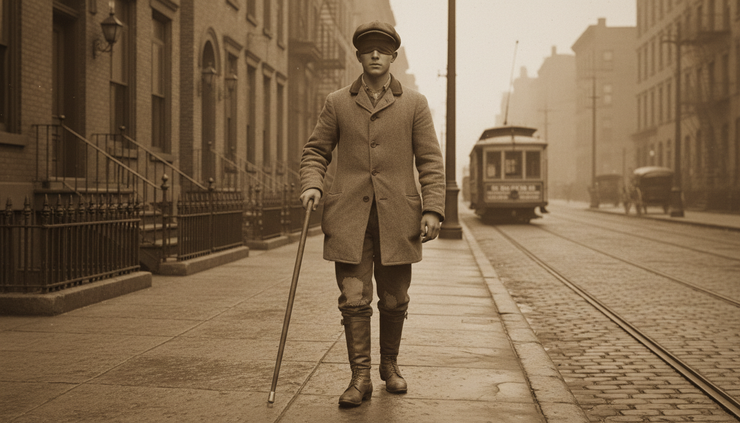
Bolotin’s family did not have wealth or social power to smooth his path. He had to work, study, and argue his way forward. As a young person, he took jobs that demanded endurance and confidence. Accounts of his life describe him selling goods door to door and learning how to navigate the city by sound, memory, and touch.
Those details matter. They show that his later success did not come from a sheltered environment built around him. He learned to move through public spaces that were not designed for him, then pressed into institutions that did not expect him to belong.
This was one of the first quiet forms of his advocacy. Before he spoke from stages or examined patients, he challenged a public assumption simply by showing up and doing difficult work.
Education became his first major act of resistance
Bolotin wanted to become a doctor, a goal that would have been demanding for any student. For a blind student in the early 1900s, it was almost unthinkable to many people around him.
Medical education relied heavily on visual instruction. Students studied anatomy, observed clinical signs, read dense material, and trained in environments where few accommodations existed. Bolotin had to find ways to learn through listening, touch, memory, and disciplined study. He also had to convince others that blindness did not make medical judgment impossible.
He attended medical school in Chicago and became licensed to practice medicine. He is widely remembered as one of the first blind physicians in the United States, and often described as the first person born blind to become a fully licensed physician in the country. The exact phrasing varies across accounts, but the larger point is clear: his career broke a barrier that many people had treated as fixed.
His education challenged two false ideas at once.
The first was that disability meant inability. The second was that professional standards required the exclusion of disabled people. Bolotin did not ask medicine to lower its standards for him. He showed that skill could take forms that institutions had failed to recognize.
That distinction sits at the heart of disability rights. Access is not about pretending differences do not exist. It is about removing needless barriers so talent can be tested fairly.
Medicine gave him authority, but service gave his career meaning
Bolotin practiced medicine in Chicago and became known for his careful work with patients. He developed special interest in diseases of the heart and lungs, fields where listening closely to the body was central to diagnosis. In an era before today’s imaging tools, physicians depended heavily on the physical exam, patient history, and instruments such as the stethoscope.
His blindness did not prevent him from listening. In some settings, it may have sharpened the way he paid attention to sound, touch, and spoken detail. That does not mean blindness is a medical advantage in itself. It means Bolotin built a method around his own strengths, as skilled people often do when institutions stop trying to force one narrow model of competence.
He also served patients who often had limited access to good care. His work connected disability rights with a broader human concern: people deserve to be treated with dignity when they are vulnerable. Patients do not become less worthy because they are poor, ill, foreign-born, disabled, or socially dismissed.
That belief flowed through his career. The doctor who had been underestimated became someone others turned to for help.

His public speaking made disability a civic issue
Bolotin did not keep his message inside hospitals. He became a public lecturer and spoke about blindness, work, and social responsibility. His speeches urged the public to see blind people as capable workers and citizens.
This was a bold position for his time. Many charitable campaigns portrayed disabled people as objects of sympathy. Bolotin argued for something stronger. He wanted opportunity, training, and respect. He believed blind people should have the chance to earn a living and build independent lives.
That message placed him ahead of many public conversations of his era. He did not use all the terms that later disability rights movements would develop, but the substance of his argument was deeply familiar to modern readers:
Equal worth
A disabled person’s value does not depend on productivity, wealth, or public approval.
Access to education
Schools and professional programs should not close doors based on fear or habit.
Economic opportunity
Work should be open to people who can do the job, including those who do it differently.
Freedom from stereotypes
Disability should not be treated as a complete description of a person’s abilities or character.
Bolotin understood that laws and institutions matter, but he also understood the power of public imagination. If society could not picture a blind doctor, a blind student, a blind worker, or a blind leader, then policy would follow that failure of imagination.
So he gave people a new image. He stood before them as evidence.
Charity was not enough for him
One of Bolotin’s most important contributions was the way he pushed beyond charity. Charity can relieve suffering, and it often comes from real compassion. But charity alone can leave the old power structure untouched. It can keep disabled people dependent on the goodwill of others instead of recognizing their rights.
Bolotin’s life pointed toward a different model. He wanted blind people to receive training, tools, and fair chances. He wanted them to be treated as people with futures.
This is why his story belongs in the history of human rights, not only in the history of medicine. Human rights begin with the idea that every person has inherent dignity. That dignity does not appear when a person becomes useful to society. It exists from the start.
For disabled people, that idea has often been denied in subtle and open ways. Denial can look like a school refusing to admit a student. It can look like an employer assuming a worker cannot perform a task without asking. It can look like public spaces designed as if only some bodies matter.
Bolotin confronted those attitudes long before disability rights became a widely recognized legal field. His tools were education, public speech, professional excellence, and personal example.

The limits he faced show the scale of his achievement
It is easy to flatten Bolotin’s life into a simple inspirational story. That would miss the point.
He did not succeed because barriers were absent. He succeeded while barriers were everywhere. He lived in a society with few formal accommodations, limited public understanding of disability, and strong prejudice against immigrants, poor people, and anyone whose body or senses did not fit the expected norm.
He also lived a short life. Bolotin died in 1924, still in his 30s. His early death makes his accomplishments even more striking, but it should not turn him into a symbol only. He was a working physician, a son of immigrants, a blind professional, and a public advocate navigating real pressure.
The better lesson is not that determination can solve every injustice. It cannot. Many capable people are blocked by systems that individual effort alone cannot overcome. Bolotin’s life shows both truths at the same time:
Personal courage matters.
Talent can appear in unexpected forms.
Representation can change minds.
Social barriers still need to be removed.
Institutions often fail when they define ability too narrowly.
Rights should not depend on one person being exceptional.
That balance is crucial. Bolotin’s achievements deserve admiration, but disabled people should not have to become extraordinary before society grants them basic respect.
Why his legacy still feels current
Modern disability rights have advanced in ways Bolotin did not live to see. The United States now has civil rights protections for disabled people, including the Americans with Disabilities Act. Schools, workplaces, transportation systems, and public services face legal duties that did not exist in his lifetime.
Yet many of the questions Bolotin raised remain alive.
Who gets encouraged toward ambitious education? Who is assumed capable before they prove anything? Who has to explain their needs again and again? Who is praised for “overcoming” barriers that should not have been there in the first place?
Bolotin’s life keeps those questions concrete. He reminds us that access is not an abstract policy topic. It decides whether a student can enter a classroom, whether a patient can trust a doctor, whether a worker can earn a living, and whether a person can move through public life without being reduced to a stereotype.
His legacy also challenges the way society tells stories about disability. Too often, disabled figures are described only through struggle or heroism. Bolotin’s story contains both struggle and achievement, but it also contains skill, ambition, service, frustration, discipline, and ordinary human complexity.
That complexity is more respectful. It lets him be a full person, not a lesson wrapped in biography.

What Jacob Bolotin’s life asks of us now
The most lasting part of Bolotin’s story is not that he became a blind doctor. It is that he made room for others to imagine disabled people as students, workers, professionals, neighbors, and leaders.
That shift in imagination matters because exclusion often begins before a rule is written down. It begins when people decide what someone else cannot do. It begins when schools, employers, and public institutions build around a narrow idea of the “normal” person.
Jacob Bolotin broke through that narrow idea. He did it at personal cost and without the legal protections later generations would fight to secure. His life stands as an early American example of disability advocacy rooted in dignity, work, education, and equal human worth.
The takeaway is simple, but demanding: access should never depend on a person having to prove their humanity. Bolotin proved his talent many times over. His deeper message was that disabled people should not have to fight so hard just to be given the chance.


Comments