Louis Braille and the Invention That Opened Reading to the Blind

A child in rural France injured his eye with a sharp tool. That accident could have narrowed his world forever. Instead, it set the stage for one of the most important inventions in the history of reading.
Louis Braille did not set out to become famous. He wanted something more practical and far more personal: a way to read and write with speed, privacy, and independence. Before his system existed, blind students often learned from raised print letters. Those books were huge, slow to read, and hard to make. Writing was even more difficult.
Braille changed that. With a simple cell of raised dots, he gave blind readers a code they could feel under their fingertips and use anywhere. The idea was small enough to fit under one finger, but large enough to reshape education, music, work, and daily life.
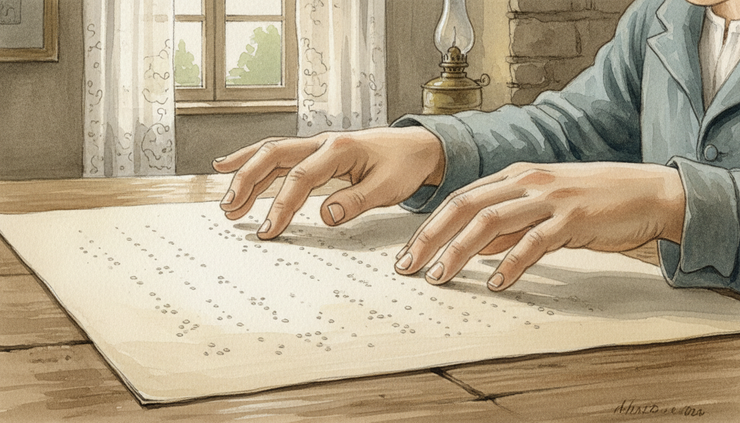
A childhood accident changed his path
Louis Braille was born on January 4, 1809, in Coupvray, a village east of Paris. His father, Simon-René Braille, worked as a harness maker. Leather, tools, straps, and metal fittings were part of the family’s daily life.
When Louis was about three years old, he picked up an awl in his father’s workshop. The tool slipped and injured one of his eyes. Infection spread to the other eye, and Louis lost his sight completely as a young child.
His blindness did not stop his curiosity. He learned his way around the village. He listened carefully. He memorized what others read aloud. By many accounts, he showed a sharp mind and a strong memory early on.
At the time, education for blind children was limited. Many people assumed blindness meant dependence. Louis’s family and local supporters did not accept that view. They helped him attend local school at first, where he learned by listening.
That early experience matters. Louis did not grow up without language, ideas, or ambition. He knew what learning felt like. He also knew its limits when books stayed out of reach.
The school that gave him tools and frustration
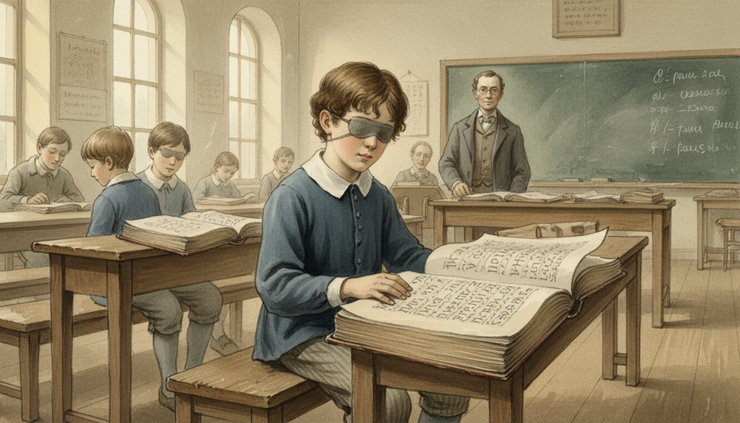
At age 10, Louis earned a place at the Royal Institute for Blind Youth in Paris. It was one of the first schools of its kind, and it gave blind students access to education that few had elsewhere.
The school used raised print books. Sighted letters were pressed into thick paper so students could trace their shapes with their fingers. This was better than no books at all, but it had serious flaws.
Raised print was:
Bulky
A single book could take up a lot of space because each raised letter needed room.
Slow
Tracing the outline of a printed letter took time, especially across whole pages.
Hard to write
Students could read raised print, but they could not easily create it for themselves.
That last problem was especially important. Reading alone does not make a full education. Students need to take notes, solve problems, write letters, copy music, and record their own thoughts.
Louis was a strong student, but he lived with the same barrier as others at the school. He could learn from materials made for him, yet he needed a system he could control himself.
The military code that sparked a better idea
The breakthrough began with an invention that was not designed for blind readers.
Charles Barbier, a French army officer, created a raised-dot system known as “night writing.” Soldiers could use it to read messages by touch in the dark without speaking or lighting a lamp. The system used patterns of raised dots to represent sounds.
When Barbier brought his method to the Royal Institute, Louis Braille recognized its promise. Reading by dots was faster than tracing raised letters. Dots were easier to feel, easier to arrange, and easier to write with simple tools.
But Barbier’s system was too complex for everyday use. Its cells were large. It represented sounds rather than letters. It did not fit neatly under one fingertip.
Louis saw what needed to change.
He reduced the system to a six-dot cell, arranged in two columns of three dots. Different combinations of those six dots could represent letters, punctuation, numbers, and later music notation. The cell was compact, regular, and efficient.
This was the genius of braille. It did not try to copy print. It used touch on its own terms.
A printed letter, such as “A” or “B,” is made for the eye. It has lines, curves, and empty spaces that vision can take in quickly. A fingertip works differently. It feels pressure, position, and pattern. Louis designed for that sense, not against it.
A teenager solved a problem adults had missed
Louis began working on his system while still a student. He was only about 15 when he developed the early form of braille around 1824.
That fact can sound almost unreal. Yet it makes sense when seen from his life. Adults around him had sympathy, skill, and authority. Louis had daily experience with the problem. He knew exactly how slow raised print felt. He knew what it meant to depend on others for writing. He knew the difference between a clever device and one that would actually work in a student’s hands.
His system gave blind readers three powerful advantages.
First, it was compact. A braille cell fit under the fingertip, so a reader could recognize a character in one touch instead of tracing a shape.
Second, it was writeable. With a slate and stylus, a person could press dots into paper. That placed writing within reach, not just reading.
Third, it was flexible. Braille could handle letters, numbers, punctuation, math, and music. Louis himself was a skilled musician, so the ability to write music mattered deeply.
He published a description of his system in 1829 and later revised it. Even then, acceptance did not come quickly. New ideas often struggle when they ask institutions to change habits. Some teachers preferred raised print because it looked familiar to sighted people. Braille did not look like ordinary writing. Its value depended on how it felt.
The students understood sooner than many adults did. They used it because it worked.

Braille became more than an alphabet
The word “braille” often makes people think of dots on elevator buttons or signs outside public rooms. Those are real uses, but they only hint at the system’s reach.
Braille is a full literacy tool. It supports spelling, grammar, punctuation, math, science, and music. It allows a reader to notice how words are built. It lets someone scan, reread, compare, and study without waiting for another person’s voice.
Audio books and screen readers are valuable. They give fast access to information, and many blind people use them every day. Braille serves a different need. It gives direct contact with written language.
That difference matters for:
Learning spelling and punctuation
Reading math problems and musical scores
Labeling household items or personal notes
Giving speeches from notes without looking at a screen
Reading quietly in places where sound would interrupt others
Braille also changed privacy. A person could read a letter, keep a journal, or study a subject without needing someone else to read aloud. That kind of independence can be easy to overlook if print has always been available.
The invention that opened reading to the blind did more than make books accessible. It made written thought more personal.
Recognition came slowly
Louis Braille became a teacher at the Royal Institute for Blind Youth. He taught grammar, history, geometry, and music. He also worked as an organist, a role that showed his skill and discipline beyond the classroom.
His health suffered for much of his adult life, likely due to tuberculosis. He died on January 6, 1852, only two days after his 43rd birthday.
He did not live to see the full global reach of his invention.
France officially adopted braille at the school level after his death. Over time, the system spread across countries and languages. Different languages adapted braille to their own alphabets and writing rules. English braille developed its own contractions to make reading and writing faster. Music braille gave blind musicians a way to study scores independently.
In the 20th and 21st centuries, braille moved onto new tools. Refreshable braille displays now raise and lower tiny pins to create changing lines of text. Braille embossers print raised dots on paper. Electronic notetakers combine braille input with digital files.
The core idea remains the same: six dots, arranged with care, read by touch.
Why his invention still matters
It can be tempting to think technology has replaced braille. With phones, audio books, and voice assistants, information can speak. That is useful, but spoken access is not the same as literacy.
Listening can deliver content. Braille shows structure.
A listener hears a sentence go by. A braille reader can pause on a comma, check a spelling, compare two words, or study a line of music note by note. For students, writers, lawyers, musicians, programmers, and anyone who works closely with language, that level of contact matters.
Braille also gives choice. A sighted reader might choose print, audio, captions, or digital text depending on the moment. Blind readers benefit from the same range of options. Accessibility should widen choices, not replace one tool with another.
Louis Braille’s work also teaches a larger lesson about design. The best solutions often come from people who live with the problem. Louis did not create a system that made blindness disappear. He created a system that respected touch as a capable way to read.
That is why braille endures. It was not a gesture of charity. It was a practical tool built from lived knowledge.

A legacy made of six dots
Louis Braille’s life was short, but his invention traveled far beyond the school where he first tested it. His six-dot cell turned reading into something blind people could do with speed, privacy, and control. It made writing possible by touch. It gave students, musicians, workers, and everyday readers a way to handle language directly.
The most powerful part of the story is its simplicity. Six positions. Raised or flat. A fingertip moving across a page.
From that small pattern came a new path into books, music, study, and self-expression. Louis Braille did not just invent a code. He helped prove that access to reading is not a luxury. It is a doorway, and it should open for everyone.


Comments