White Cane Day Celebrating Independence and Accessibility

A white cane can look simple from a distance, just a slim tool moving across a sidewalk. Up close, it tells a bigger story. It can help someone read the ground ahead, find an open path, signal to drivers, and move through the world with more confidence.
White Cane Day is a time to recognize that independence is not created by the cane alone. It also depends on safe streets, accessible buildings, respectful attitudes, and communities that understand how to share public space. The day celebrates blind and low-vision people who use white canes, and it reminds everyone else that accessibility is a shared responsibility.

What White Cane Day honors
In the United States, October 15 is recognized as White Cane Safety Day. It dates back to the civil rights era, when national attention began to focus more clearly on the rights, skills, and full participation of blind people in public life.
The white cane itself has become a widely recognized symbol of blindness and low vision. It is also a practical mobility tool. For many people, it helps detect curbs, steps, sidewalk cracks, doors, obstacles, and changes in surface texture. It can also make a person more visible to drivers, cyclists, and pedestrians.
The heart of the day is not pity. It is respect.
White Cane Day celebrates the right to move freely, study, work, travel, shop, vote, and take part in everyday life. It recognizes that blind and low-vision people are not waiting for permission to be independent. They are already navigating the world, often with skill that sighted people never notice.
The day also points to a simple truth: accessibility works best when it is built into daily life, not treated as a special request.
The white cane is a tool, not a limitation
Many people who do not use a cane misunderstand what it means. They may see it as a sign that someone needs help with everything. That is not true.
A white cane gives information. It helps the user understand what is nearby and what is changing underfoot. Different people use different cane techniques depending on their vision, training, environment, and comfort. Some use a long white cane every day. Some use one in certain settings, such as busy intersections, public transit, dim spaces, or unfamiliar places.
The cane can serve several purposes:
Detecting obstacles before the body reaches them
Finding curbs, stairs, ramps, and doorways
Identifying surface changes, such as grass, pavement, tile, or gravel
Signaling to others that the user is blind or has low vision
Supporting independent travel without relying on another person
For a person with low vision, a cane may also reduce the mental load of travel. Instead of trying to visually scan every surface, sign, shadow, and step, the cane provides physical feedback. That can make a walk safer and less stressful.
Independence does not mean doing everything alone. It means having the tools, skills, choices, and access needed to move through life with dignity.

Accessibility is built one detail at a time
White Cane Day is also a reminder that independence depends on environments. A person may have strong mobility skills, but poor design can still make a route unsafe or exhausting.
Good accessibility often comes down to details that sighted people might overlook:
A curb ramp that leads directly into a crosswalk
A sidewalk without bikes, scooters, signs, or trash cans blocking the path
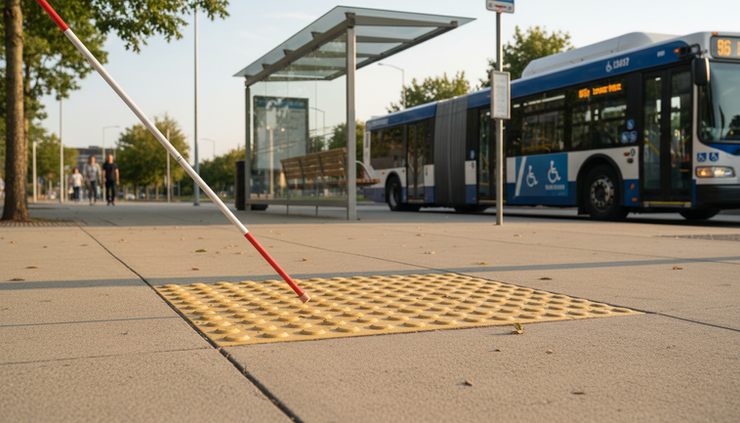
A detectable warning surface at the edge of a street or train platform
An audible pedestrian signal at a busy intersection
A bus stop with clear, consistent placement
An entrance that is easy to locate without guessing
Stairs with contrast strips and reliable handrails
Indoor paths that are not changed without notice
None of these features help only one group. Curb ramps help wheelchair users, parents pushing strollers, delivery workers, older adults, and travelers with luggage. Clear walkways help almost everyone. Good lighting and contrast help people with low vision, but they also help people who are tired, distracted, or new to an area.
That is the strength of accessibility. It improves public life for many people at once.
Common barriers hiding in plain sight
Some barriers are obvious, such as a blocked sidewalk or broken elevator. Others are easy to miss.
A restaurant may have a menu posted only on a wall. A community event may use paper signs with small print and poor contrast. A store may place seasonal displays in the middle of walking paths. A website may publish an event flyer as an image with no readable text for screen readers.
These choices can turn a routine task into a hard one.
A more accessible approach does not always require a major renovation. It can begin with habits:
Keep walkways clear
Use large, high-contrast signs
Offer digital text along with images
Make sure staff know how to give clear directions
Place objects in consistent locations
Repair uneven pavement and loose mats quickly
Use plain language when sharing instructions
Small choices add up. They can determine whether someone moves through a place smoothly or has to spend extra energy solving avoidable problems.
How to show respect around a white cane user
Many people want to be helpful, but they worry about doing the wrong thing. The best starting point is simple: treat the person as a person, not as a problem to solve.
If someone using a white cane seems lost or uncertain, it is fine to offer help. Ask first. Do not grab the person, pull the cane, or steer them by the shoulders. Sudden contact can be disorienting and unsafe.
A respectful offer sounds like this:
“Hi, would you like any help finding the entrance?”
If the answer is no, accept it. If the answer is yes, ask how the person would like to be assisted. Some might want verbal directions. Some might prefer to take your elbow and walk with you as a sighted guide. Some may only need a landmark confirmed.
Better directions make a real difference
Vague directions can be frustrating. “It’s over there” depends on sight. “Go that way” may not mean much without a clear reference point.
Useful directions are specific and grounded in the person’s position:
“The door is about 20 feet ahead on your right.”
“The counter is straight ahead, then slightly to the left.”
“There is a chair directly behind you.”
“The stairs begin in about three steps.”
“The crosswalk button is on the pole to your right.”
When speaking, use normal language. Words like “see,” “look,” and “watch” are part of everyday speech, and many blind people use them too. There is no need to become awkward or overly careful.
The larger point is respect. Ask before helping. Speak directly. Give clear information.

Myths that White Cane Day helps correct
Misunderstandings about blindness can shape public behavior, hiring decisions, school expectations, and social interactions. White Cane Day gives communities a reason to replace those myths with facts.
Myth | More accurate understanding |
All blind people see nothing. | Blindness includes a wide range of vision. Some people have no light perception, while others have limited central vision, peripheral vision, or contrast sensitivity. |
A person using a cane always needs help. | The cane is a mobility tool. Many users travel independently and only want help when they ask for it or accept an offer. |
Technology replaces the white cane. | Phones, GPS, apps, and screen readers can help, but they do not replace the ground-level information a cane provides. |
Accessibility is too complicated. | Many helpful changes are simple, such as clear paths, readable signs, consistent layouts, and accessible digital information. |
Blind people cannot do everyday activities safely. | Blind and low-vision people work, travel, cook, parent, study, play sports, and take part in community life in many different ways. |
These myths matter because they influence how people act. If someone assumes a cane user is helpless, they may grab without asking. If a business assumes blind customers will always arrive with sighted help, it may ignore accessible menus, readable websites, or clear routes.
Changing those assumptions is part of what the day is for.
Ways communities can celebrate with purpose
A meaningful White Cane Day event does not have to be large. It should center dignity, access, and the voices of blind and low-vision people.
Schools, libraries, neighborhood groups, transit agencies, local governments, faith communities, and small businesses can all take part. The best activities do more than raise awareness for a day. They lead to changes people can feel the next week, the next month, and the next year.
Ideas include:
Hosting a talk led by blind and low-vision speakers
Inviting orientation and mobility specialists to explain cane travel
Reviewing sidewalks, crossings, entrances, and public facilities for access barriers
Asking local businesses to check their aisles, signage, menus, and websites
Sharing accessible event materials in text-based formats
Teaching respectful guide techniques and clear verbal directions
Encouraging drivers to learn state white cane laws and yielding rules
Creating a community access checklist and following up on repairs
For public events, accessibility should be part of the planning from the beginning. That means choosing a reachable location, sharing transit details, offering materials in accessible formats, checking sound quality, and keeping paths clear.
It also means avoiding activities that turn blindness into a novelty. Simulations where sighted people wear blindfolds can create fear or false impressions if they are not led carefully by experts. Listening to blind people describe their own skills, barriers, and experiences is usually far more useful.
Drivers and pedestrians both play a role
White canes often appear near streets, intersections, parking lots, bus stops, and train platforms. These are places where extra attention matters.
Drivers should slow down and yield when a person with a white cane is crossing or preparing to cross, following local laws and safe driving practices. The cane may be visible before the person steps into the crosswalk. That is the moment to pay attention, not the moment to rush through a turn.
Pedestrians can help by keeping sidewalks passable. A scooter left across a curb ramp can force someone into the street. A sandwich board sign in the walking path can become a collision risk. A dog leash stretched across a sidewalk can be hard to detect in time.
Shared space works when people think beyond their own route.
The goal is not special treatment. The goal is equal access to ordinary places.
The message beyond one day
White Cane Day Celebrating Independence and Accessibility is more than a date on the calendar. It is a call to notice who public spaces serve, who they leave out, and what can change.
The white cane represents movement, skill, and choice. It also asks communities to do their part. A safe crossing, a clear sidewalk, a readable website, a respectful offer of help, a well-designed entrance, these are not extras. They are pieces of everyday freedom.
The most useful way to honor White Cane Day is to carry its message into regular habits. Leave the curb ramp clear. Speak directly. Ask before helping. Fix barriers when they appear. Include accessibility in every plan, not as an afterthought, but as a normal part of building places where everyone can participate.


Comments